How We Remove Lichen, Moss & Algae From Concrete Driveways
Struggling with green and black growth on your driveway? Here’s how we safely remove lichen, moss, and algae from concrete when pressure washing alone isn’t enough.
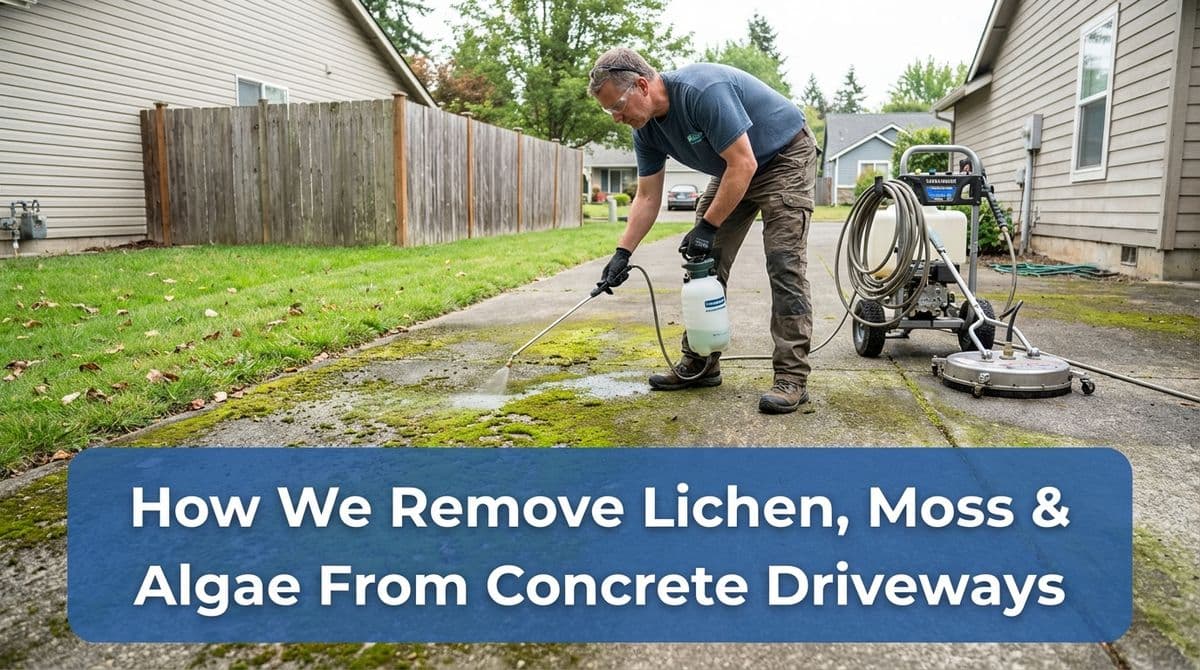
When Pressure Washing Alone Won’t Touch That Stubborn Green and Black Gunk
We recently got a call from a homeowner — let’s call him Mark — who was frustrated with his concrete driveway. He told us he’d already tried renting a pressure washer and blasting away at the surface, but there were still stubborn patches of green and black growth stuck to the concrete.
“It’s not really mildew,” he said. “It’s like this lichen-looking stuff that just won’t come off. Can you actually get rid of that?”
That question comes up a lot. Around our area, it’s common to see lichen, moss, and algae clinging to concrete driveways, patios, and sidewalks. And while a strong pressure washer can remove dirt, it often doesn’t fully solve the problem with these organic growths — at least not on its own.
What’s Actually Growing on Your Concrete?
Before we talk removal, it helps to know what you’re dealing with. When we visited Mark’s place, we saw all three common culprits:
- Algae: Thin green or black film, often slick when wet. Loves shade and moisture.
- Moss: Thicker, fuzzy green patches that feel spongy underfoot.
- Lichen: Those flattened, crusty, pale-green or gray “spots” that look almost like peeling paint fused to the concrete.
All of these are organic growths. That’s a key point, because it means they have roots or structures that anchor into the microscopic pores of your concrete. When you rely on pressure alone, you may blast off the surface layer but leave the living organism behind — and it grows right back.
Why Pressure Washing Alone Often Isn’t Enough
Mark’s driveway was a classic example. The previous year he’d rented a big-box-store pressure washer, spent a weekend blasting away, and the driveway looked cleaner… for a while. Within months, the same lichen and algae started reappearing in the same spots.
Here’s why that happens:
- Roots remain in the pores: Lichen and moss can embed into the concrete’s surface. Pressure can’t always reach those roots without risking damage.
- Higher pressure can etch the concrete: Cranking up PSI to “win” the battle can strip away the cream layer of the concrete, leaving permanent lines and rough spots.
- No kill, no cure: If you don’t actually kill the organic growth, you’re just giving it a fresh, roughed-up surface to latch onto again.
That’s why we told Mark the same thing we tell a lot of homeowners: the trick isn’t just more pressure — it’s the right combination of pressure and chemistry.
How We Safely Remove Lichen, Moss, and Algae From Concrete
On Mark’s job, we walked him through our process step-by-step. You can use a similar approach at home, but if you’re ever unsure about chemicals or equipment, it’s smart to call a pro.
1. Pre-rinse and prep the area
We start by clearing the driveway of vehicles, furniture, and planters, then doing a light rinse to remove loose dirt and debris. Nearby plants get a good soak with fresh water first — this helps protect landscaping from any chemical overspray.
2. Apply an appropriate cleaning solution
This is where we go beyond simple pressure washing. For organic growths like lichen, moss, algae, and that “black mold-looking stuff,” we use a biocidal cleaning solution formulated for exterior surfaces. The goal is to:
- Break down the organic material
- Kill the growth at its roots
- Disinfect the surface to slow regrowth
We apply the solution evenly across the concrete and let it dwell for a set time — long enough to work, but not so long that it dries out. This dwell time is critical; rushing this step is one reason DIY attempts often underperform.
3. Gentle but effective pressure rinse
Once the chemistry has done its job loosening up the growth, we rinse using enough pressure to remove the dead material without chewing up the surface. On most residential driveways, that means staying in a safe PSI range and using the right tips or a surface cleaner to keep the clean even and streak-free.
Because the lichen and moss have already been weakened chemically, you don’t need extreme pressure to get them off — which is safer for your concrete.
The Secret Weapon: Post-Treating the Concrete
When Mark first called, he asked if we could “get rid of” the lichen, not just make it look better. That’s why we emphasized our post-treatment step.
After the main cleaning and rinse, we apply a light, controlled application of cleaner to the surface as a post-treatment. This does a few important things:
- Targets any microscopic growth that survived the initial clean
- Helps keep algae and moss from immediately recolonizing the concrete
- Extends how long the driveway stays bright and clean between services
Think of it like weed killer after you’ve already pulled the weeds. You’ve removed the visible problem, and now you’re helping make sure it doesn’t come right back.
Safety Tips for Homeowners Considering DIY
If you’re planning to tackle lichen, moss, and algae on your own driveway, here are some practical safety and success tips:
- Test a small area first: Check how your concrete reacts to both the cleaner and your pressure setting.
- Avoid too much pressure: More isn’t always better. Excess PSI can etch the surface or blow out control joints.
- Protect plants and pets: Pre-rinse and cover delicate landscaping; keep pets away until the area is fully rinsed and dry.
- Wear proper gear: Eye protection, gloves, and non-slip footwear are a must.
- Follow product directions exactly: Never mix chemicals unless the label specifically says it’s safe.
How to Keep Your Driveway Cleaner, Longer
Once we finished with Mark’s driveway, we talked about how to keep that fresh look as long as possible. A few simple habits make a big difference:
- Improve drainage: Standing water encourages algae and moss. Keep gutters, downspouts, and nearby drains clear.
- Trim back shade: A little more sunlight can dramatically slow down moisture-loving growths.
- Regular light rinses: A quick hose-down during wet seasons can keep spores and dirt from building up.
- Consider sealing: In some cases, a properly applied concrete sealer can help reduce how deeply growth can attach.
Not Sure What’s Growing on Your Concrete? We Can Help.
If your driveway has stubborn green, black, or crusty patches that don’t budge with a basic wash, you’re probably dealing with the same kind of lichen, moss, and algae that Mark was fighting.
We’re happy to come out, take a look, and recommend the best combination of pressure and chemistry to clean it safely. And while we’re there, we can also check the rest of your exterior — house siding, walkways, patios — and let you know if anything else could benefit from a professional wash.
You don’t have to live with a slippery, stained driveway. With the right approach, even the toughest organic growths can be removed, killed, and kept at bay.